
Dangerous Neighborhoods in Las Vegas

Las Vegas is not a city you can split into "safe" and "dangerous" neighborhoods. Most visitors spend their time in a narrow band of resorts, garages, pedestrian bridges and entertainment blocks, and the risks they face there are usually theft, scams, alcohol-related problems and late-night isolation rather than random violence. What follows is a corridor-by-corridor, hour-by-hour guide written the way a well-traveled local would brief a friend: calm, specific and honest about what the data can and cannot tell you.
One principle runs through this whole guide: risk in Las Vegas is highly localized. It changes with crowd density, alcohol, parking layouts and the gaps between brightly lit properties. A block that feels busy and fine at 9 p.m. can feel very different at 3 a.m. when the foot traffic drains away. Think in blocks, stops and times, not in ZIP codes.
How to read Las Vegas crime numbers without being misled
The Las Vegas Metropolitan Police Department (LVMPD) publishes weekly crime reports and homicide statistics on its official statistics page, and those reports are built on reported incidents. That matters, because a reported-incident count is a raw count, not a rate, and raw counts naturally pile up wherever the most people are.
The Strip is the clearest example. Tens of thousands of visitors, workers and drivers pass through it every day, but very few people actually live there. Any crime rate calculated per resident will look extreme for a resort corridor simply because the denominator is tiny. A high count on the Strip reflects crowd volume as much as individual risk, and it should not be read as "the Strip is the most dangerous place in town."
Jurisdiction adds another layer. LVMPD covers the City of Las Vegas and unincorporated Clark County, which includes most of the Strip resorts. Downtown and Fremont Street sit inside city limits, while Henderson and North Las Vegas run their own police departments and publish their own figures. Comparing a "Las Vegas" number from one source with a Henderson number from another is often an apples-to-oranges comparison.
- Raw counts tell you where incidents were reported, which is heavily shaped by how many people are present.
- Rates tell you incidents relative to a population, which can be distorted in tourist zones with few residents.
- Single events, however serious, do not turn an entire district into a hotspot.
- Third-party "most dangerous" lists often mix sources, years and boundaries, so treat them with skepticism.
Which is the most dangerous neighborhood in Las Vegas?
The honest answer is that there is no reliable, official citywide ranking that names one neighborhood as "the most dangerous," and anyone who gives you a confident single answer is usually repackaging a third-party list. LVMPD's public statistics are organized around reported incidents and department reporting areas, not a league table of neighborhoods.
What you can say with confidence is that visitor risk concentrates in specific conditions: dense crowds where pickpockets work, nightlife zones where alcohol lowers judgment, large parking structures late at night, and poorly lit walking gaps between busy properties. Those conditions exist in pockets across the valley, including on the Strip itself.
Serious incidents do happen in visitor areas. In June 2025, LVMPD reported a homicide on a block of South Las Vegas Boulevard and announced an arrest the following day. That confirms that serious crime can occur on the Strip, but one event does not make every resort district a hotspot, and it certainly does not describe the experience of the overwhelming majority of visitors.
So instead of asking "which neighborhood is most dangerous," the more useful question for a traveler is "which specific places and hours deserve extra attention?" The sections below answer exactly that.
Citywide crime at a glance
How Las Vegas compares as a whole
Official FBI figures for the entire city, not a single neighborhood: offenses per 100,000 residents in 2025, reported by the Las Vegas Metropolitan Police Department. Crime is concentrated in a few areas, so most of the city sits well below these averages.
Violent crime
413 per 100k
1.3× the US rate
-14% since 2021
Murder, rape, robbery and aggravated assault · 7,062 offenses in 2025
Property crime
2,425 per 100k
1.6× the US rate
-6% since 2021
Burglary, theft, vehicle theft and arson · 41,516 offenses in 2025
Source: FBI Crime Data Explorer. Dashed line: US average. Police jurisdiction may not match city limits exactly. How we use this data
Micro-areas and corridors that deserve extra awareness
This is not an official hotspot list and it is not a judgment about the communities around these places. These are visitor-facing corridors where the combination of crowds, alcohol, darkness or isolation calls for sharper situational awareness, especially late at night.
Where to take extra care
Circles show approximate areas, not exact borders. Tap a zone for details.
Crowded Strip sidewalks and pedestrian bridges
The busiest stretches of Las Vegas Boulevard, the pedestrian bridges and escalators, and the choke points outside major resorts are where distraction theft thrives. LVMPD specifically warns that thieves exploit busy places, distractions, gaming areas and retail areas.
- Street performers and costumed characters draw crowds that create cover for pickpockets; watch your phone while you watch the show.
- Bridge escalators bunch people together, which is a classic moment for a bag to be unzipped.
- Someone thrusting a flyer, card or "free" item into your hand may be setting up a tip demand or a distraction.
Fremont Street and its late-night edges
The canopy area of the Fremont Street Experience is heavily trafficked and patrolled, and it is a lively, largely visitor-focused space in the evening. In 2024, the Las Vegas Sun reported that Metro attributed a drop in crime around Fremont Street in part to bans for repeat offenders.
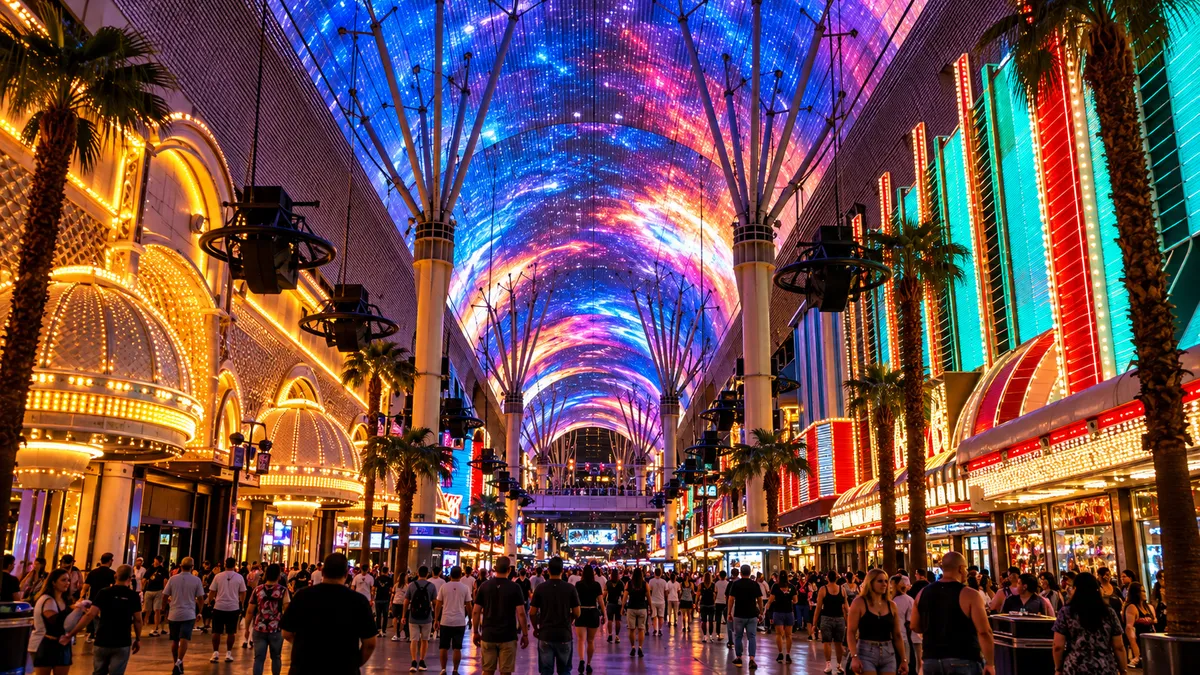
The nuance is at the edges. As you move away from the canopy and the brightest blocks, foot traffic thins, and the walk back to a distant garage, motel or bus stop late at night is where you should stay alert and avoid walking alone. If you are staying beyond the immediate core, a short rideshare after midnight is money well spent.
The walking gap between the north end of the Strip and downtown
On a map, the resorts at the north end of the Strip look walkable to downtown. In practice, the stretch of Las Vegas Boulevard between them has long sections with far less foot traffic, fewer open businesses and less lighting than the resort core. Nothing about that makes the surrounding community "dangerous," but it is a poor late-night walk for a visitor carrying a phone and cash.
The practical rule: ride this segment rather than walk it, especially after dark. The Deuce bus, a taxi or rideshare turns an uncomfortable half hour on foot into a short, uneventful trip.
Large parking structures after midnight
Resort and downtown garages are huge, multi-level and quiet in the small hours. The main visitor risks are car break-ins, theft of anything visible, and the vulnerability of walking alone through an empty level while distracted or intoxicated.
Isolated bus stops and off-Strip motel corridors
Some older motel and budget-lodging stretches off the main resort corridor offer low prices but less security, less lighting and fewer people around at night. Likewise, a bus stop that is busy at 7 p.m. can be nearly deserted at 2 a.m. Judge each stop and each property on what you see at the hour you will actually use it.
The visitor risks that actually matter most
For most travelers, the realistic threats are property crime, scams and alcohol-related vulnerability. LVMPD's tourist safety guidance is refreshingly practical, and it matches what locals see every weekend.
- Keep your phone out of sight when you are not using it; a phone on a bar top or table edge is an easy grab.
- Carry your wallet in a front pocket rather than a back pocket.
- Hold bags under your arm and keep zippers closed in crowds.
- Skip the flashy jewelry, especially when walking between properties.
- Never hang a purse on a chair or leave it on the floor at a slot machine or table game.
Casino floors and gaming areas
Gaming areas are full of distractions by design. Chip and voucher theft, grab-and-go snatches of phones and bags, and strangers striking up friendly conversation while an accomplice watches your belongings are all worth guarding against. Keep one hand or one leg in contact with your bag while you play.
Nightlife, drinks and new "friends"
Nightlife creates its own exposure. LVMPD advises visitors not to accept drinks from strangers, and the simplest habits are the most effective: watch your drink being poured, keep it in your hand, and do not return to a drink you left unattended. Agree on a meeting point with your group before a club, and never let a friend leave alone with someone you just met.
Scams you are likely to meet
- Aggressive "free" offers, such as show tickets or gifts, that turn into a hard sales pitch or a tip demand.
- Photos with costumed characters followed by pressure for payment; agree on any price before the camera comes out.
- Unsolicited "help" at ATMs or kiosks; decline politely and use machines inside the resort.
- Unlicensed rides offered on the curb; use official taxi lines or app-based rideshare pickup zones.
Timing: when the same block changes character
Time of day is one of the strongest predictors of how a place feels in Las Vegas. The Strip's resort core stays busy around the clock, but the connective tissue between properties does not.
- Daytime and early evening: crowds are at their densest, so pickpocketing and distraction theft are the main concerns.
- Late evening: alcohol consumption climbs, and so do disputes, lost phones and poor decisions about who to trust.
- After midnight: foot traffic thins between properties and away from Fremont's core, making isolation the bigger risk.
- Pre-dawn hours: garages, bus stops and side streets are quietest; ride rather than walk whenever possible.
Big weekends, major fights, conventions and holidays change the pattern again. More people means more opportunity for theft, longer waits for rides and more intoxicated crowds, so plan your exit before the event ends.
Late-night and parking guidance
Most late-night trouble for visitors comes from a predictable chain of small decisions: one more drink, a "shortcut" through an empty level, a walk to save a ride fare. Break the chain early.
- Park on a busy, well-lit level close to elevators and resort entrances, and note your level and row with a photo.
- Leave nothing visible in the car, not even charging cables or shopping bags, which signal that something may be inside.
- Walk to your car with a companion after midnight, or ask resort security for an escort if you feel uneasy.
- Have your keys ready before you reach the car and lock doors as soon as you are in.
- Do not drive after drinking; the city runs on rideshare and taxis precisely so you do not have to.
- Keep your phone charged; a dead battery late at night removes your map, your ride app and your emergency line.
Getting around safely: transit, rides and walking
The Regional Transportation Commission of Southern Nevada (RTC) runs the valley's bus network, and its transit information pages are the authoritative source for routes, fares and schedules. The Strip-focused Deuce route is the one most visitors use, and it is a sensible way to avoid long late-night walks between resorts or to downtown.
- Check the schedule in advance on the RTC site or app so you are not waiting long at a quiet stop.
- Choose stops in front of busy resorts rather than isolated shelters when you have a choice.
- Sit near the driver late at night and keep your phone and bag close.
- The Las Vegas Monorail runs behind several east-side resorts and is a straightforward option for hopping along that side of the Strip.
- Use designated rideshare and taxi zones at resorts, and confirm the plate and driver name before getting in.
Walking the Strip in daylight or early evening is part of the experience and generally straightforward if you watch your belongings and stay hydrated in the heat. The distances, however, are longer than they look, and summer temperatures are a genuine safety issue in their own right. Carry water and plan shaded routes through resort interiors.
Sensible bases for your stay
Rather than ranking neighborhoods, it is more useful to describe what makes a base feel secure for a visitor: steady foot traffic, visible security, good lighting, and short, easy trips to where you want to spend your evenings.
- The central resort corridor of the Strip: large properties with around-the-clock staff and security, busy sidewalks and walkable access to many attractions. The trade-off is crowds and pickpocket exposure.
- Downtown hotels in the Fremont core: convenient for Fremont Street nights and often cheaper, but plan rides for late returns if your hotel is beyond the brightest blocks.
- Resorts just off the Strip: quieter and often better value, with the caveat that you will rely more on rides rather than walking at night.
- Suburban areas and separate cities such as Henderson: calmer settings for families and longer stays, where a car or rideshare budget becomes essential.
Whatever you choose, look at the property itself, not the label. Check how the entrance looks at night on street-view imagery, read recent reviews for comments on security and parking, and make sure your walk from the door to transit or dining is short and well lit.
Emergencies and who to call
In any emergency involving danger to life, a crime in progress, fire or a medical crisis, call 911 immediately. Give the name of the resort or the nearest cross street, which is far more useful to dispatchers than a vague "on the Strip."
- Non-emergency police matters in the LVMPD area can be reported through 311, including many minor thefts after the fact.
- Resort security is usually the fastest help inside a property; any staff member can summon them.
- City of Las Vegas Marshals patrol city parks and facilities, alongside LVMPD.
- Henderson and North Las Vegas have their own police departments if your problem happens there.
- Lost or stolen phones and cards: freeze cards through your bank app straight away and report the loss to hotel security.
Before you go out, save your hotel's address and phone number in your phone and on a card in your wallet. If your phone is stolen, that single piece of paper gets you home.
A quick safety checklist before you head out
- Phone charged, with a portable battery for long nights.
- Only the cash and cards you need, with a backup card left in the room safe.
- Meeting point agreed with your group in case you get separated.
- Ride home planned before the night starts, not after the last drink.
- Water in your bag in warm months, even at night.
Frequently asked questions
Is the Las Vegas Strip dangerous for tourists?
For most visitors, the Strip is busy, heavily staffed and generally manageable . The main risks are pickpocketing, distraction theft, scams and alcohol-related problems. Serious incidents do occur, as LVMPD's June 2025 homicide report shows, but one event does not define the whole corridor .
Is Fremont Street safe at night?
The canopy area is lively and patrolled , and local reporting in 2024 linked a drop in crime around Fremont Street to bans for repeat offenders. The bigger consideration is the walk away from the core late at night, so take a ride if your hotel or car is beyond the brightest blocks.
Can I walk from the Strip to downtown?
You can, but it is not a recommended late-night walk . The stretch between the north end of the Strip and downtown has long sections with less foot traffic and lighting. Use the Deuce, a taxi or rideshare instead, especially after dark.
Are Las Vegas crime rates misleading for the Strip?
They can be. A rate calculated per resident looks inflated where few people live but huge numbers visit . Raw counts, meanwhile, rise simply because crowds are larger. Neither number alone tells you your personal risk as a visitor.
Is public transit safe to use late at night?
Buses like the Deuce are a sensible alternative to long night walks . Check RTC schedules in advance, wait at busy resort-front stops, and sit near the driver if the bus is quiet.
What should I do if my phone or wallet is stolen?
Is Henderson safer than Las Vegas?
Henderson is a separate city with its own police department , so its statistics are not directly comparable with LVMPD figures. It offers a calmer, more residential base, but compare like with like before drawing conclusions from any ranking.
Las Vegas rewards travelers who stay alert without becoming anxious. Guard your phone in crowds, watch your drink, ride rather than walk the quiet gaps after midnight, and choose a base with good lighting and short trips home. Do that, and the city's real dangers shrink to the size of a few simple habits.
This guide is general safety information, not a guarantee of safety. Conditions change; check local news and official sources before you go. In an emergency, call 911.