Dangerous Neighborhoods in Washington, DC
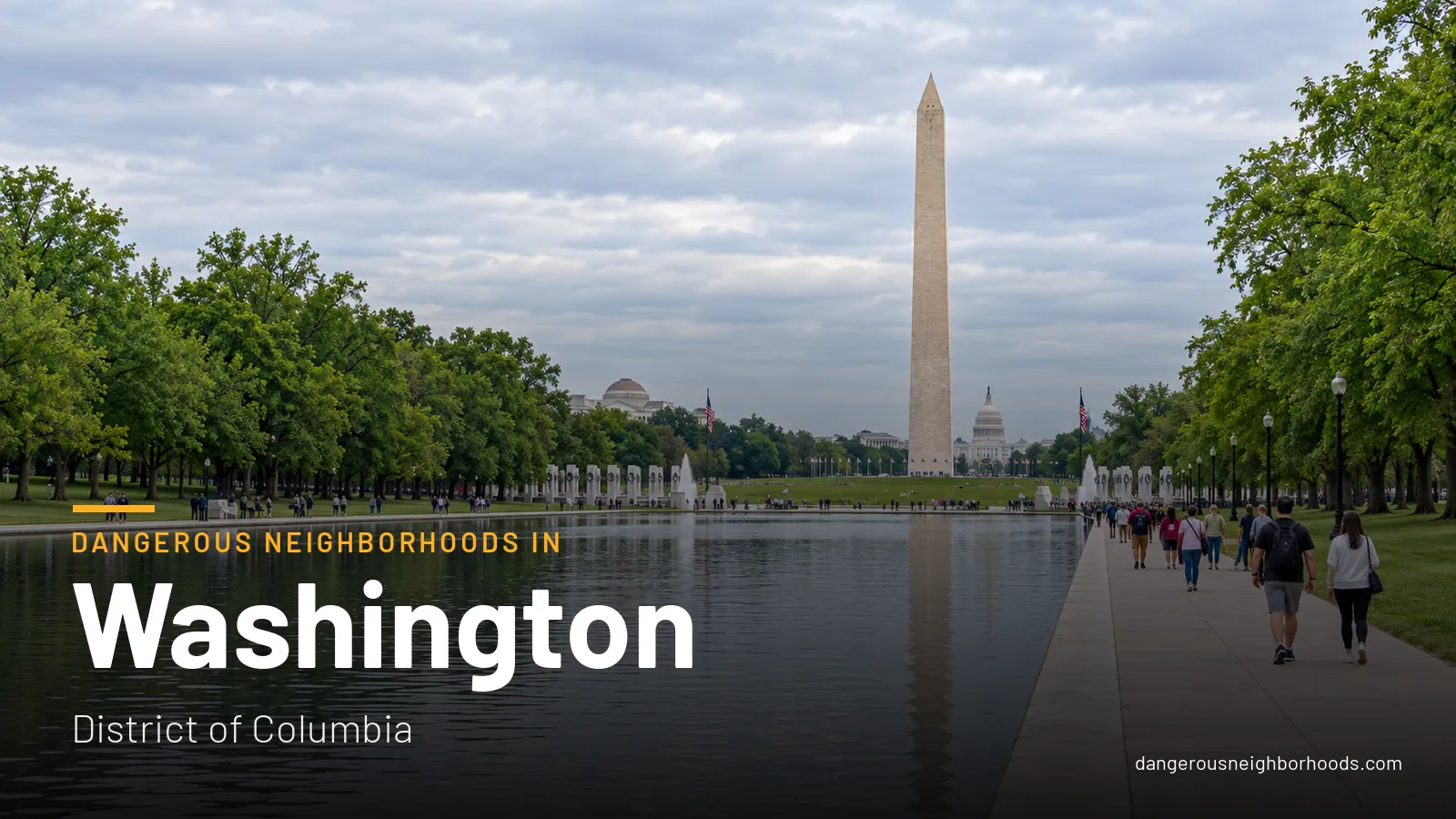
Here's the short answer nobody on cable news gives you. Serious violence in DC is concentrated in a handful of neighborhoods, mostly east of the Anacostia River in Wards 7 and 8, plus a few pockets of Northeast and the upper 14th Street corridor. If you stick to the Mall, Georgetown, Dupont or Capitol Hill, you're playing a very different game.
So, is Washington safe? Safer than it's been in a long time. Homicides fell from 274 in 2023 to 127 in 2025, and 2026 has tracked lower still, with National Guard troops and federal agents on patrol since August 2025. But "safer" doesn't mean "safe everywhere", and the gap between the best and worst blocks is brutal.
The perception problem cuts both ways. Some headlines make DC sound like a war zone, while people in Ward 3 act like crime only happens on TV. The truth is that this is a block-by-block city, and knowing which blocks matters more than any national talking point.
Why the crime map splits along a river
The Anacostia River is more than geography. Wards 7 and 8 hold roughly 11% of the city's population but accounted for close to 60% of its homicides in 2024. Decades of poverty, disinvestment and easy guns built that imbalance, and it hasn't gone away.
Then came 2023, the worst year in a generation. Police staffing sat at half-century lows, carjackings exploded and the dangerous parts of Washington bled into "nice" neighborhoods in a way locals hadn't seen since the 90s.
The federal surge of 2025 pushed numbers down hard, but the improvement has been uneven. Even with troops on the streets, there were stretches in 2026 when violence ticked back up for weeks, a reminder that the trend line is not a straight line.
Gentrification moved the money, not the problem
Shaw, NoMa, H Street and Navy Yard went from rough to luxury in about fifteen years. That's great for brunch, but it put wealth right next to deep poverty, and street robbers noticed.
The result is a city where a million-dollar rowhouse can sit three blocks from an active drug corner. Understanding that patchwork is the whole game in DC.
The neighborhoods locals actually warn you about
These are the worst neighborhoods in Washington by violent crime, not by vibe. The vast majority of people living here are working families, but shootings cluster in these streets year after year.
Areas to avoid
Safer areas to stay
Circles show approximate areas, not exact borders. Tap a zone for details.
Congress Heights
Ward 8, Southeast. The stretches around Martin Luther King Jr. Avenue SE, Alabama Avenue and Wahler Place post some of the highest violent crime figures in DC. Most of it is crew beef and retaliation, not random attacks on outsiders.
The new arena at St. Elizabeths East brings visitors in for games and events. Drive or ride in, go straight to the venue and don't wander off the main drag afterwards.
Washington Highlands
The southern tip of the city, right against the Maryland line. Wheeler Road SE and the surrounding apartment complexes see repeated shootings and very few visitors, which makes outsiders stand out immediately.
There's nothing here for a tourist, and that's the point. If your GPS routes you through on foot, take the car or rideshare instead.
Anacostia and Barry Farm
Historic Anacostia has the Frederick Douglass house, the Anacostia Arts Center and a decent strip on Good Hope Road. The trouble is the surrounding blocks, and the Anacostia Metro station after dark, which has a long record of robberies and fights.
Come for Frederick Douglass, eat on MLK, then head home. Around here, trouble starts when the sun goes down.
Deanwood, Benning Road and Kenilworth
Ward 7, Northeast of the river. The Benning Road and Minnesota Avenue corridors, plus the blocks off Kenilworth Avenue NE, are known for drug turf and retaliatory shootings. Ward 7 regularly rivals Ward 8 in monthly homicide counts.
Daytime errands are usually uneventful. Problems spike at night around corner stores and apartment courtyards, so don't linger.
Trinidad and Carver Langston
Ward 5, right behind trendy H Street NE. People bar-hop on H Street and then stumble north into Trinidad looking for parking or a shortcut, and that's where robberies and stray-shot incidents happen.
Carver Langston, east along Benning Road, has a similar profile. Great food is nearby, but stay on the lit commercial strip after midnight.
Columbia Heights around 14th Street and Park Road
Busy, diverse and full of great pupusas. But the Metro plaza at 14th and Park, plus the blocks heading toward Georgia Avenue, see recurring robberies and phone snatching, with occasional shootings on side streets.
Navy Yard and the Wharf
Yes, the shiny waterfront. It's not dangerous in the shooting sense, but robberies have followed the money here, and large weekend "teen takeovers" have pushed the city to use juvenile curfew zones.
Risk at a glance, block by block
Here's a quick cheat sheet of the areas to avoid in Washington and what actually goes wrong in each one.
| Neighborhood | Risk level | What actually goes wrong |
|---|---|---|
| Congress Heights | Very high | Gun violence, crew retaliation |
| Washington Highlands | Very high | Shootings, isolation |
| Anacostia and Barry Farm | High | Robbery, shootings after dark |
| Deanwood, Benning Road and Kenilworth | High | Drug turf violence |
| Trinidad and Carver Langston | Moderate to high | Robbery, nightlife spillover |
| Columbia Heights (14th and Park) | Moderate | Phone snatching, street robbery |
| Navy Yard and the Wharf | Low to moderate | Robbery, teen group disorder |
Which is the most dangerous neighborhood in Washington?
If you put the question to a room full of cops, social workers and longtime residents, the answer comes back fast. It's Congress Heights.
Ward 8 has led the city in homicides for most of the past decade. By mid-August 2025, it alone accounted for roughly a quarter of all killings in DC, and that violence is packed into a few corridors around MLK Avenue and Alabama Avenue SE.
That said, it's a community with churches, schools and residents fighting hard for their neighborhood. Visitors heading to the arena or a community event are rarely targets, but random walking at night is a bad idea.
Citywide crime at a glance
How Washington compares as a whole
Official FBI figures for the entire city, not a single neighborhood: offenses per 100,000 residents in 2025, reported by the Washington Police Department. Crime is concentrated in a few areas, so most of the city sits well below these averages.
Violent crime
750 per 100k
2.3× the US rate
0% since 2022
Murder, rape, robbery and aggravated assault · 5,200 offenses in 2025
Property crime
3,098 per 100k
2.0× the US rate
-12% since 2022
Burglary, theft, vehicle theft and arson · 21,490 offenses in 2025
Source: FBI Crime Data Explorer. Dashed line: US average. No complete data for 2021. Police jurisdiction may not match city limits exactly. How we use this data
DC's carjacking problem hasn't fully disappeared
In 2023, DC logged close to a thousand carjackings, many at gunpoint and many by teenagers. It was the city's signature crime, and it happened in rich and poor neighborhoods alike, at gas stations, in driveways and at red lights.
Numbers have dropped sharply since then, but car crime still shapes how locals behave. Vehicle break-ins remain common, and idling in a parked car is still the classic setup.
How to avoid becoming a carjacking statistic
Most carjackings follow the same few patterns. Breaking them is mostly about not giving anyone an easy window.
- Lock your doors the second you get in, and don't sit scrolling while parked.
- Leave space in front of you at lights so you have room to pull away.
- Be extra alert at late-night gas stations and drive-thrus.
- If you're bumped from behind in a quiet area, drive to a lit public place before stopping.
- If it happens, hand over the keys immediately. No car is worth a bullet.
Areas that are slipping and worth watching
Not every problem area is east of the river. Some central spots have declined noticeably in recent years, even if they still look polished on Instagram.
Gallery Place and Chinatown, around the Capital One Arena, became known for fights, open drug use and chaotic crowds on weekend nights. It's fine before a game, less fine at 1 a.m.
Union Station has struggled with homelessness, assaults and disorder inside and around the building. The U Street and Shaw nightlife strip has also had late-night shootings near closing time, so treat it like a party zone, not a safe zone.
Street smarts that actually work in DC
Forget generic advice. These are the Washington safety tips that locals actually live by, ranked by how often they save people trouble.
- Top 1. Keep your phone in your pocket on Metro platforms and near train doors. Snatch-and-run is constant.
- Top 2. Know which side of the river your destination is on before booking a cheap Airbnb.
- Top 3. Use rideshare after midnight instead of walking long stretches alone.
- Top 4. Never leave anything visible in your car, not even a charging cable.
- Top 5. Avoid large groups of teens at night in Navy Yard and Gallery Place, and cross the street early if needed.
- Top 6. Check the station before riding the Green Line deep into Southeast, because some stops empty out fast at night.
- Top 7. If someone pulls a weapon, give them what they want and walk away.
- Top 8. Save the MPD tip line and Metro Transit Police number, because 911 isn't the only option.
Do's and don'ts for getting around DC
Keep this list in mind and you'll blend in like a local.
Do
- Walk with purpose and confidence, even if you're lost.
- Sit near the train operator on late-night Metro rides.
- Enjoy Anacostia's museums and murals in daylight hours.
Don't
- Argue with aggressive panhandlers, especially near Union Station.
- Take shortcuts through dark alleys and apartment courtyards.
- Flash cash, jewelry or expensive camera gear at night.
Who to call and how to move around without drama
Save these before you land. In a bad moment, nobody wants to be googling phone numbers.
- EmergencyCall 911 for any emergency, from a robbery to a medical crisis.
- EmergencyMPD tips go to 202-727-9099 or text 50411, and you can stay anonymous.
- Getting aroundMetro Transit Police answer at 202-962-2121 for anything on trains or in stations.
- MedicalFor serious injuries, MedStar Washington Hospital Center is the region's main trauma center, and GW Hospital sits in Foggy Bottom.
- Getting aroundRideshare is the safest late-night option, so always check the plate before getting in.
- Getting aroundCapital Bikeshare is great for daytime, but avoid docking in deserted areas after dark.
Metro hours change depending on the day, and Sunday nights close earlier than weekends. Always check the last train time before heading out.
After dark the map changes
A neighborhood that feels fine at 3 p.m. can feel completely different at 2 a.m. In DC, the bad areas in Washington get worse at night, but so do the nightlife strips at closing time.
Adams Morgan on 18th Street, U Street and 14th Street are packed until last call. The real risk comes when bars empty out, with fights, drunk drivers and robberies of people waiting on the sidewalk for their ride.
Nothing good happens on 18th Street after last call. Get your Uber before the lights come on.
Walking the National Mall at night to see the lit monuments is popular and generally safe in groups, but the darker edges near the Tidal Basin get very quiet after 11 p.m.
The safest neighborhoods in Washington to base yourself
Where you stay sets the tone for the whole trip. These areas offer low risk and easy access to the sights.
Georgetown
Cobblestones, boutiques and riverside walks. Property crime happens, but violent incidents are rare, and it feels calm even late at night. The only downside is no Metro stop.
Capitol Hill
Beautiful rowhouses, Eastern Market and quick access to the Mall. The core is very safe, but edges toward the east can get rougher.
Dupont Circle
Lively, walkable and full of embassies, cafés and bars. It's one of the best all-around bases for first-time visitors.
Cleveland Park and Woodley Park
Ward 3 territory near the National Zoo, with the lowest homicide rate in the city. Even here it's not European-level quiet, but it's as close as DC gets.
Foggy Bottom and West End
Close to the Kennedy Center, the Lincoln Memorial and George Washington University. It's polished, well-patrolled and quiet after business hours.
Solo female travelers in DC, the honest version
DC is one of the easier US cities for women traveling alone, as long as you choose a safe base. The main annoyances are street harassment and catcalling, which happen more often near busy Metro hubs than in quiet residential areas.
Nightlife is where caution matters most. Watch your drink at all times in crowded U Street and Adams Morgan bars, and leave with the people you came with.
How the stranded commuter hustle works at Union Station
It's not violent, but it's one of the most common hustles visitors face in DC. It works because it plays on your good intentions.
- A well-dressed person approaches you near Union Station with a polished, believable story.
- They say they lost their wallet or their card was declined, and they're stuck without a train or bus ticket.
- They name an exact amount, often $20 to $40, which makes the story sound specific and real.
- If you hesitate, they add pressure with a crying child, a sick relative or "my last train leaves in ten minutes".
- Once you pay, they head back inside to repeat the routine with someone else.
If you want to help, offer to buy the ticket yourself at the counter. A real stranded traveler will accept, while a hustler usually disappears.
Quick answers before you go
Still unsure about something? These answers cover the questions visitors ask most.
Is it safe to walk at night in Washington?
In central areas like Dupont Circle, Georgetown, Capitol Hill and the Mall, walking at night is generally fine in normal conditions. Avoid long solo walks east of the river, and take rideshare after bars close.
Is the DC Metro safe?
For the most part, yes, especially during the day. Most incidents are phone snatching and fights, and they’re more common at certain stations late at night.
Is all of Southeast DC dangerous?
No. Navy Yard and much of Capitol Hill are technically in Southeast. The higher-risk zones are mostly east of the Anacostia River, in Wards 7 and 8.
Is crime in Washington getting better or worse?
Overall, it’s much better than the 2023 peak, with homicides cut by more than half. Still, the progress isn’t even, and certain neighborhoods remain hot spots.
See the capital, skip the gamble
DC is not the war zone some people describe, and it's not a postcard either. Most visitors spend a week here without seeing anything worse than an overpriced museum café.
The trick is simple. Stay on the right side of the river, use rideshare late at night and keep your phone out of sight on the Metro. Do that, and the city's risks stay mostly in the headlines.
Go see the monuments at night, eat your way through Shaw, take the trip to the Douglass house in Anacostia while it's light out. Just respect the block you're on, because in DC, that's what really counts.
This guide is general safety information, not a guarantee of safety. Conditions change; check local news and official sources before you go. In an emergency, call 911.