Dangerous neighborhoods in Philadelphia
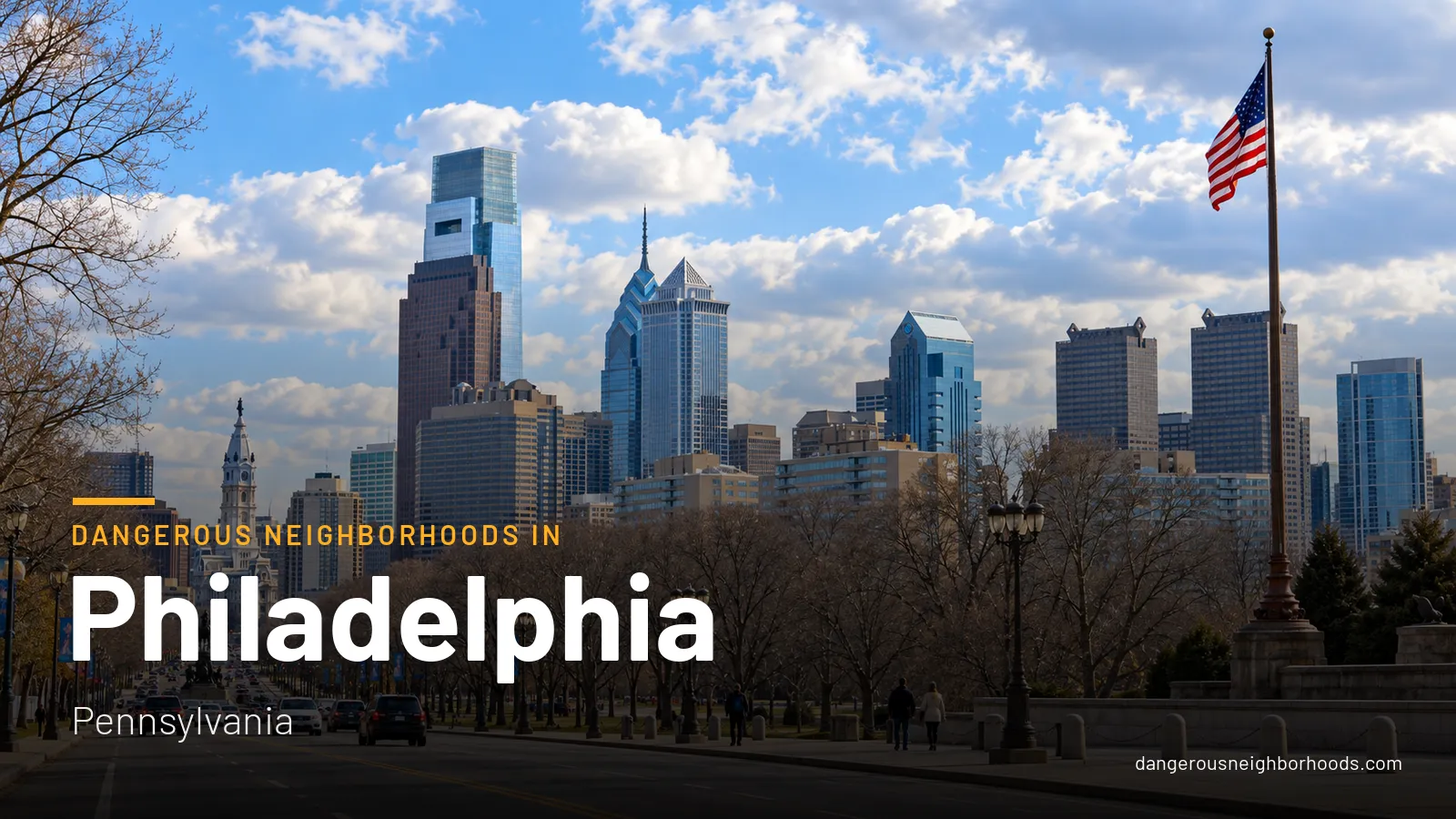
Let's get straight to it. The most dangerous neighborhoods in Philadelphia are clustered in North and Northeast-adjacent Philly: Kensington, Tioga-Nicetown, Strawberry Mansion, Fairhill and Hunting Park. If you're a visitor, you have almost zero reason to be in any of them.
So, is Philadelphia safe? For most tourists, yes, with your eyes open. Homicides fell from an all-time high of 562 in 2021 to 222 in 2025, the lowest number since 1966. That's a massive turnaround, but the violence that remains is extremely concentrated.
This guide breaks down the worst neighborhoods in Philadelphia block by block, explains why they got that way, and shows you where you can relax completely. No fearmongering, no sugarcoating.
How the City of Brotherly Love got its rough edges
Philly was once an industrial powerhouse. Textile mills, factories and rail yards filled North Philadelphia with jobs. When deindustrialization hit from the 1950s onward, those jobs vanished and never came back, and the neighborhoods built around them were left hollowed out.
What followed was the classic American urban spiral: population loss, abandoned rowhouses, disinvestment and an entrenched drug trade. The numbers are still ugly. The city's violent crime rate sits at 983 per 100,000 residents according to FBI UCR data, about 139% above the national average.
But here's the nuance most articles skip. That citywide figure is dragged up by a handful of zip codes. Crime in Philadelphia is hyper-local, almost street by street, and a nice block can sit ten minutes' walk from a very bad one.
Why the 2021 peak matters for today's numbers
2021 was a nightmare year with 562 homicides. Since then, the drop has been steep: 410 in 2023, 268 in 2024, 222 in 2025. Shooting victims also fell to 935 in 2025, the first time under 1,000 since 2007.
Police Commissioner Kevin Bethel's department also posted a homicide clearance rate of 81.98% in 2025, the highest since 1984. Translation: more killers are actually getting caught, which is one of the strongest deterrents a city can have.
The neighborhoods locals tell you to skip
Here are the areas to avoid in Philadelphia, ranked by a mix of violent crime data, drug activity and what people who actually live here will tell you. None of these are tourist zones, so avoiding them costs you nothing.
Areas to avoid
Safer areas to stay
Circles show approximate areas, not exact borders. Tap a zone for details.
Kensington
Kensington is the name everyone knows, and for good reason. ABC News called Kensington Avenue the largest open-air drug market in the Northeast. Walk under the El tracks and you'll see people nodding off, open injection and a level of human suffering that shocks even seasoned travelers.
A Drexel University study found Kensington's violent crime rate runs 30% higher than the rest of the city. Most of the danger comes from the drug economy itself: turf disputes, robberies and random volatility.
Tioga-Nicetown
Tioga-Nicetown ranks as the number one most dangerous neighborhood in several data-based rankings. The median household income is just $24,935, and the shootings here rarely make national news because they're so routine.
It lacks Kensington's notoriety, but it's statistically just as rough. The danger is less visible drug chaos and more targeted gun violence between local crews.
Strawberry Mansion
The name sounds charming. The reality isn't. Strawberry Mansion posts a crime rate around 1,944 per 100,000 residents, roughly double the already-high city average.
It borders the eastern side of Fairmount Park, which is where visitors sometimes wander in by accident. Stick to the western park areas and the Schuylkill River Trail closer to Center City if you want green space.
My grandmother bought her house here in 1971 when it was all working families. The block is still good people, but you learn which corners to cross the street at before you learn to ride a bike.
Fairhill
Fairhill might be the poorest neighborhood in the entire city. About 61% of residents live below the poverty line, five times the national average, with a median income of $19,698.
Al Jazeera named the intersection of Indiana Avenue and 3rd Street the second most dangerous drug corner in the city. Fairhill blends into Kensington to the east, and the drug market spills over freely.
Hunting Park
Hunting Park has a real community core and a lovely namesake park that locals have worked hard to revive. But it also has documented gang activity, including the Latin Kings and remnants of Black Mafia networks.
The median income is $23,587. Daytime around the park is generally okay, but after dark the dynamics shift fast, especially near the Broad Street Line stop.
Frankford
Frankford sits at the end of the Market-Frankford Line, and the transit hub brings a steady flow of petty and violent crime. Frankford Avenue under the El has similar vibes to Kensington, just less concentrated.
If you're heading to Northeast Philly by train, transfer quickly and don't linger around the terminal after dark.
Kingsessing and parts of Southwest
Southwest Philadelphia, particularly Kingsessing and the stretch toward Cobbs Creek, has seen persistent shootings year after year. It's close to University City, which confuses a lot of visitors.
The border between polished Penn campus and rough blocks is abrupt. Heading west past 50th Street is where you should start paying real attention.
A quick danger map by the numbers
| Neighborhood | What drives the risk | Visitor risk level |
|---|---|---|
| Kensington | Open-air drug market, overdoses, robbery | Extreme |
| Tioga-Nicetown | Gun violence between local crews | Extreme |
| Strawberry Mansion | Crime rate near 1,944 per 100k | Very high |
| Fairhill | Deep poverty, drug corners | Very high |
| Hunting Park | Gang activity, night robberies | High |
| Frankford | Transit-hub crime under the El | High |
| Kingsessing | Recurring shootings | High |
Which is the most dangerous neighborhood in Philadelphia?
The answer is Kensington. Other neighborhoods may edge it out on a single statistic in a given year, but no place in Philly combines drug activity, overdoses, violent crime and sheer visibility the way Kensington does.
The epicenter runs along Kensington Avenue under the Market-Frankford El, roughly from Somerset to Allegheny. City crackdowns in recent years have pushed some of the activity onto side streets, which means the problem moved more than it disappeared.
If you're not a resident, outreach worker or journalist with a reason to be there, Kensington Avenue is simply not a place for you. The good news is that it's far from anything a visitor would normally seek out.
Citywide crime at a glance
How Philadelphia compares as a whole
Official FBI figures for the entire city, not a single neighborhood: offenses per 100,000 residents in 2025, reported by the Philadelphia Police Department. Crime is concentrated in a few areas, so most of the city sits well below these averages.
Violent crime
831 per 100k
2.5× the US rate
-16% since 2021
Murder, rape, robbery and aggravated assault · 12,979 offenses in 2025
Property crime
4,355 per 100k
2.8× the US rate
+34% since 2021
Burglary, theft, vehicle theft and arson · 68,036 offenses in 2025
Source: FBI Crime Data Explorer. Dashed line: US average. Police jurisdiction may not match city limits exactly. How we use this data
The tranq crisis that makes Philly different
Every big American city has drugs. What makes Philadelphia unique is what's in the supply. Philly became ground zero for xylazine, the animal tranquilizer nicknamed "tranq" or the "zombie drug."
Xylazine turned up in 38% of all overdose deaths. It causes deep sedation and horrific skin wounds that can lead to amputations, which explains a lot of what visitors see on Kensington Avenue.
Medetomidine and the newest shift
In 2025, a newer sedative called medetomidine was found in 80% of Kensington drug samples. It's even more potent, and its withdrawal is brutal enough to send people to the ER.
There's a sliver of good news. Drug overdose deaths dropped to 1,069 in 2024, down 18% from the prior year. Still, that's roughly three people dying every single day.
For visitors, the practical takeaway is simple: heavy sedation means unpredictable behavior. Someone can seem unconscious one second and agitated the next. Give people space and don't intervene physically; call 911 if someone looks in danger.
Honorable mentions worth knowing
These aren't in the same tier as the list above, but they're still among the dangerous parts of Philadelphia where you should keep your guard up, especially at night.
- Grays Ferry: pockets of violence close to gentrifying South Philly blocks.
- Point Breeze (southern edges): rapidly changing, but mixed block by block.
- Cobbs Creek: recurring shootings near the western city limit.
- Olney: rising property crime and occasional violent incidents.
- Parts of West Philly beyond 52nd Street: lively commercial strip, rough side streets.
Top 10 rules for staying safe in Philly
These Philadelphia safety tips come from people who live here, not from a brochure. Follow most of them and you'll be fine.
- Know your block edges. Neighborhoods change within a few streets. Check your route before you walk.
- Keep your phone in hand only when needed. Phone snatching is common, especially on SEPTA.
- Never leave anything visible in your car. Not a bag, not a charger cable, nothing.
- Use rideshare after 10pm if you're crossing into unfamiliar areas.
- Don't follow your GPS blindly. "Shortest route" can mean straight through Fairhill.
- Stay out of Kensington, full stop. Curiosity is not a good enough reason.
- Sit near the train operator on late-night SEPTA rides.
- Lock your doors while driving in North Philly; carjackings do happen at lights.
- Don't engage with aggressive panhandlers. A firm "sorry" and keep moving.
- Trust the vibe. If a street feels empty and wrong, turn around.
Street-smart dos and don'ts
Do
- Walk with purpose, like you know where you're going.
- Use well-lit main avenues like Broad, Market and Walnut.
- Park in staffed garages rather than street lots near museums.
Don't
- Flash expensive jewelry or cameras in North Philly.
- Wear headphones in both ears on empty streets at night.
- Take photos of people in distress or drug corners.
Getting around and getting help fast
Knowing who to call and how to move is half of staying safe. Philly's transit is useful but has weak spots you need to know.
- Emergency911 for any emergency. Philly police response in Center City is generally fast.
- Emergency311 (Philly311) for non-emergency issues like abandoned cars or broken streetlights.
- Getting aroundSEPTA Transit Police: report incidents to staff or use the SEPTA app's reporting options.
- MedicalTrauma centers: Temple University Hospital, Penn Presbyterian and Thomas Jefferson University Hospital.
- Getting aroundUber and Lyft are widely available and the safest late-night option.
- Getting aroundIndego bike share works well in Center City, University City and Fishtown during the day.
Driving? Auto theft hit 10,045 vehicles year to date in 2026. The museum lots along the Benjamin Franklin Parkway are known targets, so use a staffed garage when visiting the Art Museum or the Barnes.
Carjackings are also spreading into previously quiet areas, including parts of South Philly and the Northeast. Keep doors locked and leave space in front of you at red lights.
After the sun goes down
Philly's nightlife is excellent, and most of it happens in neighborhoods that are genuinely safe: Rittenhouse, Old City, Fishtown, Northern Liberties and East Passyunk.
The risk at night isn't really the bars. It's the walk or ride home through transitional blocks. Northern Liberties can bleed into rougher streets heading north, and Fishtown borders Kensington more closely than people realize.
Fishtown on a Saturday night is fantastic. I just tell every friend who visits the same thing, don't walk north to save five bucks on an Uber.
South Street is fun but can get rowdy after midnight, especially on warm weekends. Large teen gatherings have led to police crackdowns in past summers, so leave if a crowd starts to feel tense.
The safest neighborhoods in Philadelphia
Now the good part. Philly has plenty of neighborhoods where you can walk around at night without a second thought. These are where you should stay and spend most of your time.
Rittenhouse Square
Rittenhouse is Philly's upscale core, with a crime rate around 420 per 100,000, less than half the city average. Great restaurants, leafy streets and a constant police presence.
Chestnut Hill
Chestnut Hill feels like a New England village inside city limits. Crime here runs about 23% below the national average, and Germantown Avenue's cobblestones are perfect for a slow afternoon.
Old City
Home to Independence Hall and the Liberty Bell, Old City is packed with tourists and patrols. Petty theft is the main concern, not violent crime.
Fishtown
Fishtown is the city's hottest neighborhood for food, coffee and music. It's safe in its core, but respect the northern boundary near Kensington.
Bustleton
Up in the Far Northeast, Bustleton posts about 62% less crime than the city average. It's residential and quiet, a solid pick for families or longer stays on a budget.
A guide for women traveling solo in Philly
Solo female travelers generally find Philly friendly and very walkable in the central neighborhoods. Rittenhouse, Washington Square West and Old City are ideal bases.
The main annoyances are catcalling and aggressive panhandling near transit hubs like 15th Street and City Hall stations. A firm tone and steady pace usually ends the interaction.
Book accommodation east of the Schuylkill and south of Spring Garden Street, and you'll be in the safest possible zone for walking home.
The fake parking attendant hustle
This one catches visitors every year, especially around big events, stadiums and the Parkway. It's low-tech but surprisingly effective on out-of-towners.
- You pull up near a busy venue looking for parking, clearly unsure where to go.
- A guy in a reflective vest waves you into a lot or onto a curb and says it's $20 or $30 cash.
- He promises to "watch the car" and may even hand you a handwritten ticket.
- You come back to a parking ticket, a tow, or a broken window and missing bag.
- The "attendant" is long gone, and the lot never belonged to him.
The fix is easy: only pay at official kiosks, apps or staffed garages. Philly uses the meterUP app for street parking, and legitimate lots never need a random guy in a vest.
Questions visitors actually ask about Philly safety
These are the questions that come up again and again. Here are straight answers without the spin.
Is Philadelphia safe for tourists right now?
Yes, for most tourists sticking to Center City, Old City, Fishtown and University City. Homicides have dropped to the lowest level since 1966, and violence is heavily concentrated in neighborhoods visitors rarely enter.
Can I walk from Center City to Fishtown?
Yes, during the day it's a pleasant walk through Northern Liberties. At night, it's fine along main streets, but a rideshare is smarter if you're unsure of the route.
Is SEPTA safe to use?
Generally yes during the day and evening. The weak spots are specific stations in North Philly after 9pm and phone snatching near train doors, so keep devices out of sight.
Should I visit Kensington to see it for myself?
No. It's not a tourist attraction, residents resent spectators, and the environment is unpredictable even in daylight. There's nothing to gain and plenty to lose.
Philly rewards the prepared visitor
Philadelphia has a reputation that's both deserved and exaggerated. The bad areas in Philadelphia are genuinely rough, but they're concentrated and easy to avoid.
The trend is also on your side. Fewer homicides, fewer shootings and more cases being solved than at any point in decades. The city in 2026 is noticeably calmer than the one of 2021.
Stay central, move smart at night, keep your car empty and skip Kensington. Do that, and you'll spend your trip thinking about cheesesteaks and history, not crime.
This guide is general safety information, not a guarantee of safety. Conditions change; check local news and official sources before you go. In an emergency, call 911.